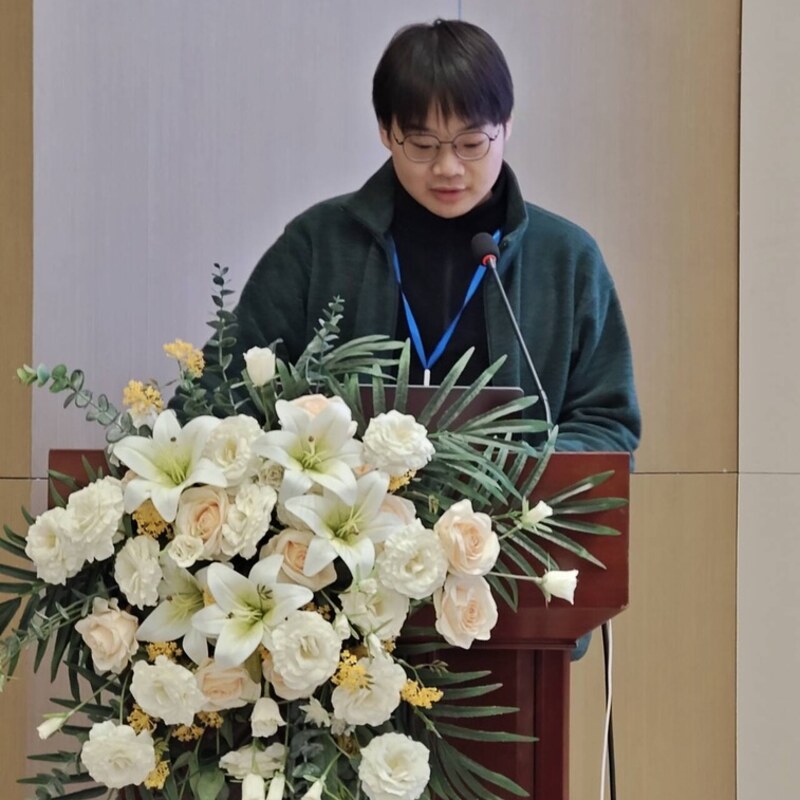
Zi-Yue Zheng

Zi-Yue Zheng (郑子岳)

PhD Student in Astroparticle Physics
Institute of Astrophysics, Central China Normal University

I study neutron-star oscillations and gravitational-wave signals, with a focus on the physics of dense matter.

About

I am a PhD student in Astroparticle Physics at the Institute of Astrophysics, Central China Normal University, advised by Prof. Xiao-Ping Zheng (郑小平). My research focuses on neutron-star oscillations and gravitational-wave signals as probes of dense matter in compact-star interiors.

Before beginning my PhD, I received my master's and bachelor's degrees from China University of Geosciences (Wuhan), where I worked under the supervision of Prof. Huan Chen (陈欢). My broader interests include compact objects, dense matter, and relativistic astrophysics.

Research Interests

Neutron Star Oscillations Dense Matter Equation of State Gravitational-Wave Astrophysics

Publications

Bold: Zi-Yue Zheng; *, †: Corresponding author.

Two-fluid $f$-mode oscillations of dark-matter-admixed neutron stars

Zi-Yue Zheng, Ting-Ting Sun, Huan Chen, Xiao-Ping Zheng*, Jin-Biao Wei, G. F. Burgio and H.-J. Schulze
Abstract

We study quadrupolar $f$-mode oscillations of dark-matter-admixed neutron stars (DANSs) in full general relativity (GR). The ordinary component is described by microscopic Brueckner-Hartree-Fock matter matched to the Shen2020 crust, while the dark matter (DM) component is treated as a cold self-interacting fermion fluid coupled to ordinary matter only by gravity. For fixed-DM-fraction sequences we solve the polar two-fluid perturbation equations with an outgoing gravitational-wave (GW) boundary condition, obtaining complex eigenfrequencies rather than only real mode frequencies. The spectrum contains two principal f-like sequences. Their local character can be ordinary-matter-led, DM-led, or mixed, and is diagnosed using the component kinetic energies, the displacement overlap, and the cancellation of the matter quadrupole. A main result is that, for intermediate DM fractions, one of the two-fluid branches can become weakly radiating, with damping times enhanced by several orders of magnitude. The same calculation gives the outgoing Zerilli amplitude and the GW damping time, which we use to estimate the GW energy required to reach a prescribed detector threshold. Thus the analysis extends previous two-fluid Cowling studies by retaining metric perturbations and the radiative boundary condition.

Quasiradial oscillations of rotating hybrid neutron stars

Zi-Yue Zheng, Ting-Ting Sun, Huan Chen*, Xiao-Ping Zheng†, Jin-Biao Wei, G. F. Burgio and H.-J. Schulze
Abstract

We investigate fundamental quasiradial oscillations in slow-rotation approximation of pure and hybrid neutron stars, employing equations of state of nuclear matter from Brueckner-Hartree-Fock theory or the relativistic mean field model, and of quark matter from the Dyson-Schwinger quark model, performing a Gibbs construction for the mixed phase in hybrid stars. Characteristic differences between neutron-star and hybrid-star fundamental quasiradial oscillation frequencies during spin-down are pointed out.

Submitted to Physical Review D

Non-radial oscillations and gravitational wave radiation of proto-neutron stars

Yi-Lun Tao, Zi-Yue Zheng, Ting-Ting Sun, Huan Chen*, Jin-Biao Wei
The European Physical Journal A, 2025
Abstract

We study the $g$-mode non-radial oscillations of proto-neutron stars during the cooling stage. Based on finite-temperature extended Brueckner–Hartree–Fock theory and the relativistic mean-field theory, and combined with appropriate crust equations of state, we construct isentropic equations of state for proto-neutron stars with neutrino trapping. Under the frozen-fluid assumption during oscillations, the difference between the adiabatic and equilibrium sound speeds gives rise to nonzero Brunt–Väisälä frequencies, which enables the existence of $g$-mode oscillations. We then study the effects of temperature and neutrino trapping on the $g$-mode frequencies under the Cowling approximation, making comparisons between results with the two EOSs and examining the impact of varying crust equations of state. Our results show that, compared with cold neutron stars, neutrino trapping significantly reduces gravity-mode frequencies in both models, and the relativistic mean-field model systematically yields lower frequencies than the Brueckner–Hartree–Fock model. Neutrino trapping also prolongs gravitational wave damping times and reduces the strain amplitudes, but predictions indicate that the signals remain within the sensitivity of current and future detectors. These findings highlight the potential of gravitational wave observations to probe the interior physics of proto-neutron stars.

$f$-mode oscillations of protoneutron stars

Zi-Yue Zheng, Ting-Ting Sun, Huan Chen, Jin-Biao Wei, Xiao-Ping Zheng*, G. F. Burgio and H.-J. Schulze
Abstract

We investigate nonradial $f$-mode oscillations of protoneutron stars in full general relativity, employing equations of state described by the Brueckner-Hartree-Fock theory or the relativistic mean field model, while assuming isentropy and fixed lepton fractions for the internal structure. The validity of various universal relations for cold neutron stars involving $f$-mode characteristics and macroscopic properties of the star is confirmed for those isentropic protoneutron stars (PNSs). Prospects of observations are also discussed. According to simulation results, we then model details of the thermal and trapping profiles in a PNS with the canonical mass. The corresponding $f$-mode frequencies and gravitational-wave strain amplitudes are presented. The validity of the universal relations during the evolution to the formation of a cold neutron star is confirmed.

$f$-mode oscillations of hybrid stars with pasta construction

Zi-Yue Zheng, Ting-Ting Sun, Jin-Biao Wei, Huan Chen*, Xiao-Ping Zheng†, G. F. Burgio and H.-J. Schulze
Abstract

We investigate nonradial $f$-mode oscillations of hybrid neutron stars in full general relativity, employing hybrid equations of state describing a nuclear outer core and a pasta-phase transition to a quark-matter core. The validity of various universal relations is confirmed for those stars. Prospects of observations are also discussed.

Radial oscillations of protoneutron stars

Ting-Ting Sun, Zi-Yue Zheng, Huan Chen*, Jin-Biao Wei, G. F. Burgio and H.-J. Schulze
Abstract

We investigate radial oscillations of protoneutron stars (PNSs), employing equations of state described by the Brueckner-Hartree-Fock theory or the relativistic mean field model, and assuming isentropy and fixed lepton fractions for the internal structure. We calculate the eigenfrequencies and corresponding oscillation functions, which show different characteristics in different mass regions. In the low-mass region around $1.4\,M_\odot$, the radial oscillation frequencies are lowered by large entropy and neutrino trapping, along with a reduction of the average adiabatic index. Therefore, during the PNS evolution to a cold neutron star, the frequency increases substantially. In the region close to the maximum mass, the fundamental oscillation frequency drops rapidly and vanishes at the maximum mass, in accordance with the critical stability criterion $\partial M/\partial \rho_c = 0$, as for cold neutron stars.

Radial oscillations of strange quark stars admixed with dark matter

Yu Zhen, Ting-Ting Sun, Jin-Biao Wei, Zi-Yue Zheng, Huan Chen*
Abstract

We investigate the equilibrium structure and radial oscillations of strange quark stars admixed with fermionic dark matter. For strange quark matter, we employ a stiff equation of state from a color-superconductivity improved bag model. For dark matter, we adopt the cold free Fermi gas model. We rederive and numerically solve the radial oscillation equations of two-fluid stars based on general relativity, in which the dark matter and strange quark matter couple through gravity and oscillate with the same frequency. Our results show that the stellar maximum mass and radius are reduced by inclusion of dark matter. As to the fundamental mode of the radial oscillations, the frequency $f_0^2$ is also reduced comparing to pure strange stars, and $f_0^2$ reaches the zero point at the maximum stellar mass with $d M/d \epsilon_{q,c} = 0$. Therefore, the stability criteria $f_0^2>0$ and $d M/d \epsilon_{q,c} > 0$ are consistent in our dark matter-mixed strange quark stars with a fixed fraction of dark matter. We also find a discontinuity of $f_0$ as functions of the stellar mass, in contrast to the continuous function in pure strange stars. And it is also accompanied with discontinuity of the oscillation amplitudes as well as a discontinuous in-phase-to-out-phase transition between oscillations of dark matter and strange quark matter.

Nonradial oscillations and gravitational wave emission of hybrid neutron stars

Zi-Yue Zheng, Ting-Ting Sun, Huan Chen*, Jin-Biao Wei, G. F. Burgio and H.-J. Schulze
Abstract

We investigate nonradial oscillations of pure and hybrid neutron stars, employing equations of state of nuclear matter from Brueckner-Hartree-Fock theory, and of quark matter from the Dyson-Schwinger quark model, performing a Gibbs construction for the mixed phase in hybrid stars. Characteristic differences between neutron-star and hybrid-star $g_1$-mode oscillation frequencies, damping times, and gravitational wave strains are pointed out. Prospects of observations are also discussed.

Equation of state and radial oscillations of neutron stars

Ting-Ting Sun, Zi-Yue Zheng, Huan Chen*, G. F. Burgio and H.-J. Schulze
Abstract

We investigate radial oscillations of pure neutron stars and hybrid stars, employing equations of state of nuclear matter from Brueckner-Hartree-Fock theory, and of quark matter from the Dyson-Schwinger quark model, performing a Gibbs construction for the mixed phase in hybrid stars. We calculate the eigenfrequencies and corresponding oscillation functions. Our results for the zero points of the first-order radial oscillation frequencies give the maximum mass of stable neutron stars, consistent with the common criterion $d M/d \rho_{c} = 0$. Possible observations of the radial oscillation frequencies could help to learn more about the equation of state, predict the maximum mass of neutron stars more precisely, and indicate the presence of quark matter.

Education

Sep 2023 - Present
Central China Normal University
Institute of Astrophysics
PhD Student in Astroparticle Physics
Advisor: Prof. Xiao-Ping Zheng (郑小平)
Sep 2020 - Jun 2023
China University of Geosciences (Wuhan)
School of Mathematics and Physics
Master's Degree in Physics
Advisor: Prof. Huan Chen (陈欢)
Sep 2016 - Jun 2020
China University of Geosciences (Wuhan)
School of Mathematics and Physics
Bachelor's Degree in Physics